Concrete Boom Pump Services
Putzmeister & Schwing heavy boom pump dispatch for commercial slabs, foundations, and elevated pours.
We dispatch Northeast Florida's most stable and high-capacity articulating concrete boom pumps. From the mid-sized 38-Meter Z-Boom, designed to unfold beneath tight steel structural framing, to the massive 47-Meter Roll-and-Fold boom, engineered to reach over bulkheads and place major yardage continuously, we guarantee safe, calculated operations.
What Is a Concrete Boom Pump?
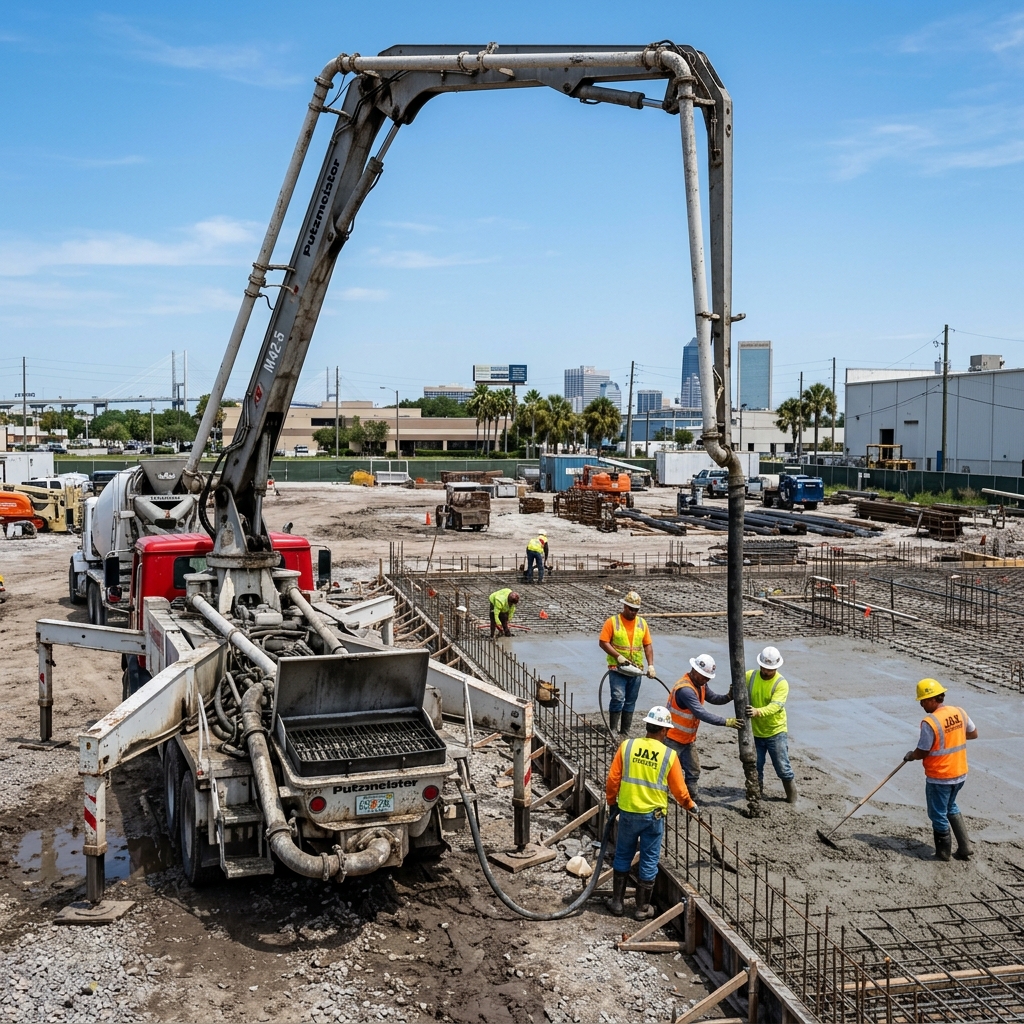
A boom pump is a truck-mounted concrete pump with a hydraulic, remote-controlled articulating arm (the "boom") that unfolds to carry concrete through a steel pipeline directly to the placement point — over rebar, around obstacles, through upper-floor window openings, or across a job site a ready-mix truck's chute could never reach on its own.
Instead of wheelbarrowing or bucket-and-crane placement, the boom lets a small placing crew direct a continuous, controllable stream of concrete exactly where it's needed, at a rate of up to 160+ cubic yards per hour on our larger rigs. That speed is what keeps a large slab pour monolithic (poured in one continuous session, without cold joints forming between batches).
You need a boom pump — rather than a ground line pump — any time the pour is large-volume, elevated, or has obstacles between the truck's staging area and the placement point: multi-story structural slabs, commercial foundations, tilt-wall panels, or any site where a hose being dragged across the ground isn't practical.
At a Glance
- Reach: 123′ to 152′ of vertical reach across our fleet
- Output: Up to 160+ cubic yards per hour
- Footprint: 25′×30′ minimum firm, level staging area
- Best for: Commercial slabs, multi-story pours, large foundations
- Operators: ACPA-certified, OSHA-compliant
Boom Rig Specifications Side-by-Side
Boom pump requirements are determined by horizontal reach hurdles and vertical clearances. Review outrigger dimensions, aggregate limits, and soil pressure specs before booking.
| Boom Rig Class | Vertical Reach | Horizontal Reach | Setup Staging Footprint | Unfolding Clearance | Max Point Pressure | Ideal Use Cases |
|---|---|---|---|---|---|---|
| 38-Meter Z-Boom | 123' 0" | 107' 0" | 25' W x 30' L | 24' 6" (Ultra-Low) | 55 PSI (Rear Outrigger) | Mid-size warehouse slabs, tight retail setbacks, residential housing blocks |
| 42-Meter Roll-Fold | 136' 0" | 121' 0" | 28' W x 32' L | 29' 0" | 62 PSI (Rear Outrigger) | Tilt-wall panel placements, commercial structural footers, parking structures |
| 47-Meter Roll-Fold | 152' 0" | 138' 0" | 30' W x 36' L | 31' 6" | 72 PSI (High Pressure) | Mass industrial foundation pours, elevated multi-story slabs, heavy port terminals |
*All outrigger pressure values assume concrete staging on sandy Northeast Florida soils. Rigid composite outrigger dunnage pads (minimum 36"x36" dimensions) are mandatorily set under all outrigger jacks to safely distribute pressure within standard building code limits.
Boom Pump or Line Pump?
Not every pour needs a boom. If your site is tight, residential, or ground-level, a trailer line pump is often the faster, more cost-effective call.
Choose a Boom Pump If…
- The pour is 50+ yards or needs to stay continuous/monolithic
- Concrete needs to reach an elevated floor, roof, or upper-story opening
- The site has obstacles — excavations, rebar grids, structural framing — between the truck and the placement point
- It's a commercial foundation, tilt-wall, or industrial slab job
Choose a Line Pump If…
- It's a residential driveway, patio, or pool deck
- The lot is tight, fenced-in, or HOA-restricted with no room to stage a boom truck
- You need masonry block fill or tight-access grouting
- Yardage is modest and ground-level hose routing is practical
Philips Highway Commercial Staging Exhibit
Explore real operational proof of our commercial placements. Inspect the active outrigger staging blueprint, concrete slump quality sheet, and live operator SMS feeds for a recent 120-yard continuous pour on Philips Highway.
Philips Hwy Warehouse Floor Staging
Drawing Ref: PM-BOOM-PHILIPSHWY
This rigging blueprint details a Putzmeister 38-Meter Z-Boom staged on a commercial retail site along the Philips Highway corridor. Large warehouse slab placements require continuous concrete flow to preserve high-spec flatness tolerances (Ff/Fl specs above 45) and eliminate weak structural joints.
By utilizing our rig's ultra-low Z-boom folding pattern, our operator successfully unfolded the boom conduit inside a tight **24'6" vertical framing clearance** and safely threaded beneath JEA distribution power lines, delivering structural concrete cleanly inside the steel framing envelope.
Argos Baymeadows Plant Field Quality Sheet
| Arrival Time | Test Type | Target Slump | Measured Slump | Mix Correction & Admixture | Temp | Pumping Status |
|---|---|---|---|---|---|---|
| 06:45 AM | Truck #1 Initial Slump | 5.00 Inches | 3.50 Inches | Added 35 oz/yd³ High-Range Water Reducer (HRWR). Spun 30 revs. No water added. | 75°F | APPROVED FOR BOOM |
| 07:05 AM | Truck #2 Hopper Slump | 5.00 Inches | 5.00 Inches | None (Mix within structural pumping tolerances) | 76°F | APPROVED FOR BOOM |
| 07:25 AM | Truck #3 Continuous Flow | 5.00 Inches | 4.75 Inches | None (Continuous placement completed) | 77°F | POUR COMPLETE |
*All field adjustments executed in strict compliance with ACI 301 structural concrete specs and FDEP environmental guidelines. HRWR superplasticizer used exclusively to adjust slump without compromising the structural water-cement design ratio. No jobsite water addition permitted to prevent shrinkage cracks.
Live Jobsite Dispatch Chat Log
Real-time SMS/Radio transceivers among the placing supervisor, operator, and ready-mix plant dispatcher during Philips Highway warehouse pour.
The Outrigger Setup Calculation
Articulating boom pumps generate massive structural forces. Under full load placing conditions, a single outrigger pad on a 47-Meter rig can apply up to **24,000 lbs** of localized force. Setting these outrigger feet directly on loose sandy Florida soils without sufficient distribution dunnage triggers severe machinery settlement and potential tipping hazards.
Our outrigger safety protocol demands systematic site preparation. GCs must clear a level staging area capable of supporting heavy truck axles. Our operators calculate exact ground bearing capacities and deploy rigid composite outrigger pads (minimum 36"x36" dimensions) stacked on heavy timber cribbing blocks to distribute forces safely, maintaining pressures well within standard building codes.
JEA Overhead Utility Clearance Code
Jacksonville and Northeast Florida features high-density overhead distribution utility lines, operated by JEA. Deploying heavy articulating booms near active high-voltage wires is highly regulated and structurally hazardous.
In strict compliance with OSHA 1926.1408 and JEA safety guidelines, all boom tips must maintain a continuous radial safety zone of **at least 10 feet** from overhead lines up to 50kV. High-voltage transmission lines require 20 feet of clearance or de-energization by JEA prior to staging. A certified crew spotter is deployed on every single boom project to track boom tip positions and ensure continuous safety.
How Boom Pump Dispatch Works
Request Availability
Tell us your yardage, target pour date, and equipment preference. We check the dispatch board and confirm fleet availability.
Confirm Site Details
We review outrigger footprint, overhead clearance, and access routes with you so the rig can stage safely on pour day.
Coordinate Ready-Mix
Our operator syncs truck spacing directly with your ready-mix plant so pumping stays continuous with zero waiting-time penalties.
Pour, Wash Out, Done
We place the concrete, complete EPA-compliant washout, and clear the site — typically within a 4-hour minimum window.
Boom Pump Pricing at a Glance
Boom pump jobs run on a standard 4-hour portal-to-portal minimum, covering travel from our Jacksonville yard, outrigger setup, pumping time, and washout. Once the minimum is met, billing shifts to a per-cubic-yard rate, with volume-adjusted pricing on commercial pours over 100 yards.
The 38-Meter Z-Boom generally runs a lower minimum than the 47-Meter Roll-and-Fold, given the larger rig's mobilization and setup requirements. An environmental washout fee applies if the general contractor doesn't provide a compliant, lined washout pit on-site.
See Full Rates & MinimumsBoom Pump FAQ
How much space does a boom pump need to set up? +
How close can a boom pump work to overhead power lines? +
How far in advance do I need to book a boom pump? +
What slump does my concrete need to be for boom pumping? +
Do I need a permit to stage a boom pump on the street? +
What happens to the leftover concrete washout? +
Boom Pump Dispatch Across Northeast Florida
Our 38-meter and 47-meter boom rigs stage out of our Jacksonville yard and run daily routes into Duval, St. Johns, Clay, and Nassau counties. Outrigger footprint, soil conditions, and overhead clearance requirements vary by area — see the local dispatch guide below for your jobsite location.