Elevated Deck Concrete Pumping Jacksonville, FL
Engineered vertical standpipe routing, placing boom coordination, and high-pressure pipeline layouts. We manage the physics of multi-story concrete placement across Northeast Florida's commercial skyline.
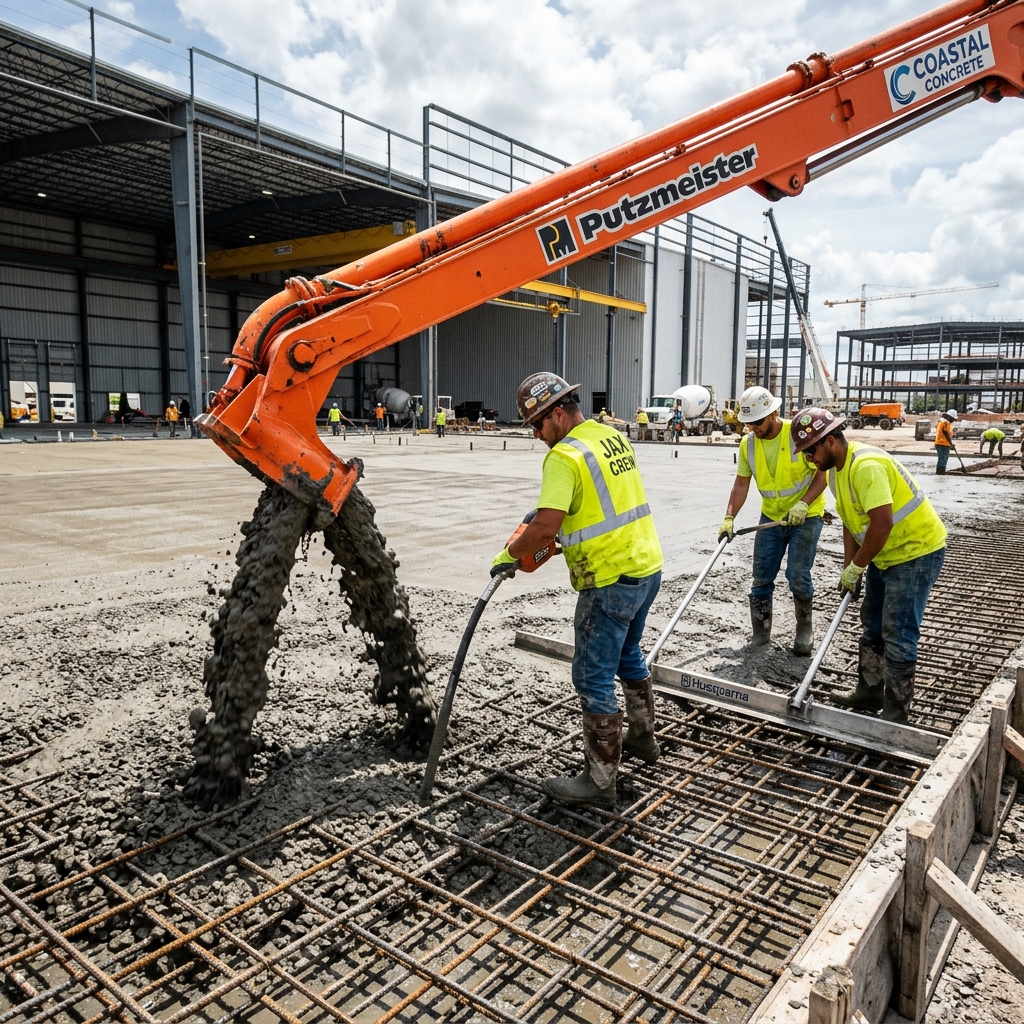
High-Pressure Standpipe Routing & Structural Anchoring
Pouring multi-story elevated concrete decks (like composite steel decking or post-tensioned slabs) means pushing tons of wet concrete straight up under immense mechanical load. When placement heights exceed what a standard 56-Meter boom truck can reach on its own, we transition our setup parameters to design and deploy a rigid **vertical high-pressure standpipe pipeline**.
Rigging a vertical standpipe is serious business. The riser pipeline has to be locked down tight using heavy-duty structural steel brackets clamped directly to the building's concrete columns or steel girders at maximum **10-foot intervals**. Down at the base, where the horizontal line transitions to the vertical riser, the pump exerts massive structural force. We require GCs to anchor a **reinforced concrete thrust block** at this transition elbow. This block absorbs the mechanical kick from the pump’s strokes, keeping the couplers from fatiguing and preventing the line from pulling apart under pressure.
"When you're pushing heavy mud up a vertical riser, the elbow at the base takes a beating. We anchor a reinforced concrete thrust block at that transition to absorb the mechanical kick and keep the couplings from fatiguing."
Placing Booms Staging & Structural Deck Loading
On sprawling elevated slabs where a standard boom truck cannot easily reach or reposition, we deploy modular **placing booms** that stage directly on your structural columns or custom placing towers. Because these systems place concentrated weight on structural floor plates, GCs must verify deck load capacities before we bolt down heavy placement machinery:
Our logistics coordinators work with you long before the pour date. We calculate exact outrigger loads and coordinate mounting plate specs directly with your engineering firm to ensure everything is 100% compliant and ready to pump.
Elevated Deck Dispatch Timeline
Multi-story placements leave zero margin for error. We follow a strict 5-step operational protocol for every vertical placement dispatched in Northeast Florida:
-
1
Pre-Pour Standpipe Audit
Our operator is on-site 1.5 hours before the mud arrives. We do a complete physical walk-down to inspect pipeline brackets, anchor clamps, wall ties, and check that the structural base thrust block is solid.
-
2
Pressure Line Testing
Before starting, we run high-pressure water through the line to check coupler seals and verify coupler integrity under working pressure before introducing concrete.
-
3
Slicking & Line Priming
We pump a concentrated slicking polymer slurry ahead of the first ready-mix load. This coats the dry steel walls of the riser pipeline so the concrete slides cleanly without packing the pipe.
-
4
Sustained High-Pressure Pumping
Once the pour starts, it has to stay moving. We coordinate closely with Cemex and Argos ready-mix plants to maintain a constant queue of trucks, preventing cold joints on the deck.
-
5
Sponge-Ball Riser Cleanout
At completion, we blow a pressurized sponge-ball through the riser. This pushes every yard of good concrete onto the deck, cleans out the pipeline, and collects the residue safely in washout bins.
Vertical Mix Matrix
Required concrete specifications for pushing mud up a vertical riser. We verify these mix parameters with your ready-mix supplier before scheduling the pump.
Higher flowability = lower friction
3/8" pea gravel for vertical standpipes
High paste coats pipe interior
Maintains slump under pressure
Standpipe Prep Checklist
Make sure you have these prerequisites fully squared away before our operator rolls onto the job. Avoiding delays keeps your project on schedule.
- Structural columns supporting placing towers verified fully cured.
- Wall bracket anchors clamped to girders at every floor level.
- Base transition elbow supported by a reinforced concrete thrust block.
- Watertight deck washout containment bags positioned at high levels.
- Ready-mix delivery queuing coordinated for continuous flow.
Multi-Story Placement Parameters
Comparative specifications for low-rise vertical runs up to complex high-rise vertical placements.
| Placement Height | Riser Pipeline Spec | Slump Target | Recommended Admixture | Max Aggregate |
|---|---|---|---|---|
| Low-Rise (Up to 35 ft) | 5" Standard Steel Pipe | 4.5" - 5.5" Slump | None to Mid plasticizer | 3/4" Round Gravel |
| Mid-Rise (35 to 120 ft) | 5" Heavy-Wall Steel | 5.0" - 6.0" Slump | Mid-Range Retarder | 3/4" Gravel (High Paste) |
| High-Rise (120+ ft) | 5" High-Pressure CX Steel | 6.0" - 7.0" Slump | High-Range Water Reducer (HRWR) | 3/8" Pea Gravel (Fine aggregate) |
Environmental Compliance: FDEP Coastal Washout Rules
Under Florida Department of Environmental Protection (FDEP) guidelines, direct discharge of elevated slurry water into coastal aquifers or structural storm drainage is strictly prohibited. Watertight containment systems are mandatory for all elevated metal deck placements in Duval and Nassau counties.
Elevated Deck Pumping FAQ
Common vertical placement and standpipe questions from Jacksonville developers and GCs.
What size vertical standpipe is required for high-rise concrete pumping? +
Most vertical runs are serviced using a rigid 5-inch steel standpipe. The heavy wall thickness is required to withstand working pressures up to 350+ PSI. Riser components are secured to structural columns with high-strength wall anchors at each floor plate.
How do you prevent pipeline blockages during a vertical pour? +
We follow a highly rigid protocol to eliminate blockage risks. We perform high-pressure hydrostatic coupling tests before starting, pump an engineered slicking polymer primer slurry through the riser, and maintain a constant ready-mix arrival queue to keep material moving continuously inside the standpipe.
Do placing booms require custom structural deck staging? +
Yes. Staging a static placing boom exerts massive localized loads on fresh structural floor plates. GCs must verify deck load metrics. We anchor placing boom towers directly to building columns that have achieved 100% curing strength and deploy dunnage cribbing to spread heavy shear weight.
Ready to Stage Your Vertical Placement?
High-rise standpipe dates require early logistics planning and site coordinate verification. Contact our dispatch planners or submit your vertical pour dimensions online to reserve your placing boom.