Warehouse Slab Concrete Pumping Jacksonville, FL
High-output concrete placing systems engineered to protect strict floor flatness (FF) and levelness (FL) tolerances. We synchronize ready-mix flow to keep your finishing crews moving wet-on-wet.
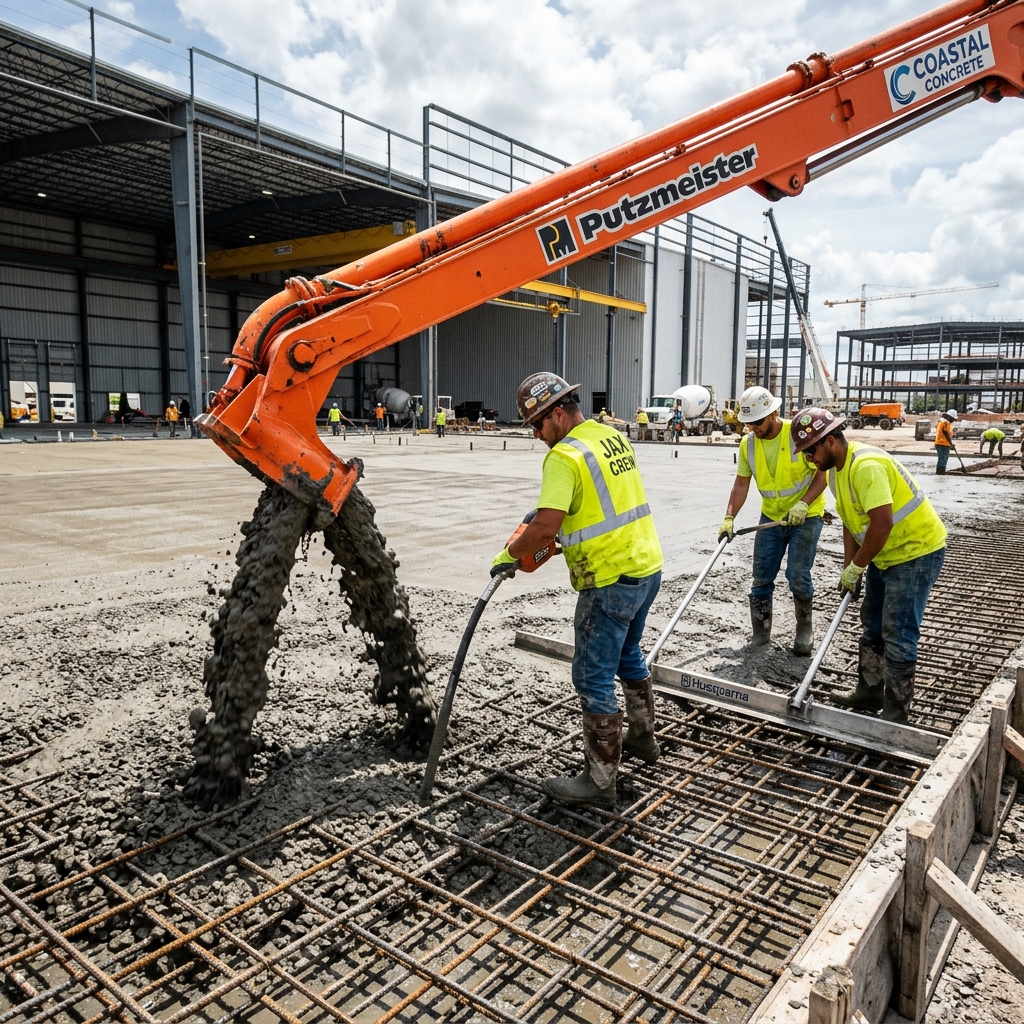
FF/FL Flatness Mechanics Under Pumping Loads
Pouring high-volume industrial warehouse floors requires strict adherence to structural flatness (FF) and levelness (FL) specifications. FF controls the surface waves, while FL manages the overall slope. In modern distribution centers with high-reach forklift masts, even minor floor deviations can cause container collisions or forklift instability.
When you're pouring superflat commercial floors, concrete hydration timing is everything. If ready-mix truck arrivals are delayed, the concrete begins to set at different rates across the placement bay. This differential hydration creates microscopic waves as your screed and trowel crews work the fresh concrete. A single delayed truck can ruin an entire section's flatness metrics, triggering expensive corrective grinding operations. We coordinate continuous, timed ready-mix queue logs to maintain a steady placing rhythm and protect your flatness targets.
"Flatness isn't a spec sheet metric; it's a wet-mud boundary battle fought every 4.5 minutes. If the pump stops for even 15 minutes due to poor ready-mix scheduling, the finishing crew will battle a cold boundary, and the floor flatness metrics will tank."
The 3-to-1 Aggregate Pumping Sizing Formula
To handle massive structural loads, commercial warehouse slabs require low-water concrete mixes mixed with heavy coarse aggregate (often 1.5-inch gravel). Pumping these coarse, dry mixes requires precise pipeline sizing to prevent aggregate interlock blockages inside the boom pipe.
The core mechanical rule of concrete pumpability states that the pipeline's internal diameter must be at least **three times** the maximum aggregate size:
Pipeline Friction Formula
Example (1.5" Coarse Aggregate Mix): 1.5" × 3 = 4.5" Minimum Pipeline Diameter. Running a smaller 4-inch pipe on a structural aggregate mix leads to immediate aggregate blockages, line pressure spikes, and catastrophic pipe blowouts.
Because of this formula, our commercial boom dispatch fleet is outfitted exclusively with 5-inch heavy-wall steel pipelines. We calculate exact outrigger loads and coordinate ready-mix batch arrivals to keep the slickline operating continuously, avoiding friction spikes and keeping the pump running cool.
Superintendent's Clipboard
Case Incident: Slump Deviation on Philips Hwy Pour
"During our 450-yard pour at the Philips Highway Logistics Center, Argos Mixer Truck #14 backed into the hopper with a load showing a slump of 3.2 Inches. On a structural mix with 1.5-inch coarse aggregate, this low flowability presented a major blockage risk in our 5-inch slickline.
I immediately halted discharge, directed the operator to hold the load, and had the ready-mix driver introduce a High-Range Water Reducer (HRWR) plasticizer admixture under strict spec sheet parameters to hit our target 4.75-inch slump. Once mixed, the load discharged cleanly, preventing a vertical pipeline blockage and maintaining our 4.5-minute truck spacing target. Zero downtime recorded."
— Chief Dispatch Superintendent, Jacksonville Concrete Pumping Co.Continuous Casting Bed Pour Timeline
Industrial floor pours leave zero margin for error. We follow a strict 5-step operational protocol for every high-yield placement dispatched in Northeast Florida:
-
1
Ready-Mix Staging Audit
Our dispatch planners establish direct batch-to-hopper transit logs, mapping distance coefficients and rush-hour bottlenecks from local Vulcan, Cemex, and Argos plants to ensure the concrete is placed well under the 90-minute batch window.
-
2
Slickline Pre-Lubrication
We pump a highly concentrated polymer slicking slurry ahead of the first ready-mix load to fully lubricate the internal walls of the 5-inch pipeline, reducing initial line friction spikes.
-
3
High-Output Slickline Placing
Operators utilize remote radio proportional controls to adjust placement speeds, matching concrete depths and avoiding shifting steel reinforcement grids.
-
4
FF/FL Wet Screed Coordination
We coordinate placing pace directly with your laser screed and trowel finishing crews to ensure the concrete stays plastic and fresh, protecting flatness limits.
-
5
Continuous Truck Spacing Flow
We keep ready-mix trucks arriving under tight 4.5-minute transit spacing, maintaining constant hopper volume and ensuring absolute placement consistency.
Slab Mix Matrix
Required concrete specifications for industrial high-flatness slabs. We verify these specs with your supplier before dispatch.
Low slump prevents bleeding & settlement
Requires 5" heavy-wall steel slickline
High paste supports high structural loads
For heavy manufacturing floor plates
Industrial Prep Checklist
General contractors must confirm these site prerequisites before our boom pump operator deploys outriggers.
- Laser screed setups and grade rails verified for flat tolerances.
- Ground compaction tests around the pump staging zone signed off.
- Water source on-site for pipeline priming and cleanout.
- Designated EPA-compliant concrete washout bag positioned.
- Mix transit queue coordinated under 4.5-minute intervals.
Jobsite Dispatch & Engineering Records
True authority isn't claimed; it's documented. Explore the real-world operational logs, rigging math, and mix adjustments that secure structural flatness targets on Northeast Florida jobsites.
Putzmeister 47M Outrigger Staging Profile
Drawing Ref: PM-47-JAX-SLAB
This rigging blueprint details outrigger point-load dispersion on standard West Jacksonville clay subgrades. Low-slump slab pumping requires extended sweeps at minimal boom angles, producing high horizontal shear force and a localized tipping coefficient.
By mandating 36" x 36" birch outrigger pads, we reduce maximum staging pressure from 72,000 lbs to a safe soil dispersion factor, preventing form shift and ensuring laser screeds travel on a perfectly stable grade.
Argos Ready-Mix Field Adjustment Sheet
| Arrival Time | Test Type | Target Slump | Measured Slump | Mix Correction & Admixture | Temp | Inspection Status |
|---|---|---|---|---|---|---|
| 05:42 AM | Truck #12 Initial Slump | 4.50 Inches | 4.25 Inches | None (Mix within structural spec tolerances) | 78°F | APPROVED FOR PUMP |
| 06:14 AM | Truck #14 Hopper Slump | 4.50 Inches | 3.25 Inches | Added 45 oz/yd³ of HRWR Superplasticizer. Spun 30 revolutions. | 81°F | CORRECTED & CLEARED |
| 07:30 AM | Truck #18 Weather Delay | 4.50 Inches | 4.50 Inches | Rain delay over I-295. Drum set to agitate. Zero jobsite water added. | 79°F | APPROVED FOR SLICKLINE |
*All field adjustments executed in strict compliance with ACI 301 structural concrete specs and FDEP environmental guidelines. HRWR superplasticizer used exclusively to adjust slump without compromising the structural water-cement design ratio. No jobsite water addition permitted.
Live Jobsite Dispatch Chat Log
Real-time SMS/Radio transceivers among the placing supervisor, operator, and ready-mix plant dispatcher during slab operations.
450-Yard Continuous Placement Log
Operational flow records from our Philips Highway logistics warehouse placement, completed under 5 hours.
| Time Interval | Placed Volume | Truck Spacing Log | Slump Check | Operational Status |
|---|---|---|---|---|
| 05:00 AM - 06:00 AM | 90 Cubic Yards | 4.5 Minutes | 4.5 Inches | Rigging complete, polymer primer pumped, continuous feed started. |
| 06:00 AM - 07:00 AM | 190 Cubic Yards | 4.0 Minutes | 4.75 Inches | Boom slewed 90 degrees to west bay. Steady operator flow. |
| 07:00 AM - 08:00 AM | 290 Cubic Yards | 5.0 Minutes | 4.5 Inches | Argos plant shift change, spaced transition log, zero downtime. |
| 08:00 AM - 09:00 AM | 390 Cubic Yards | 4.5 Minutes | 5.0 Inches | Final structural bay transition. Boom hose repositioned. |
| 09:00 AM - 09:30 AM | 450 Cubic Yards | 6.0 Minutes | 4.75 Inches | Placement complete. Safe boom cleanout into watertight EPA bags. |
Outrigger Rigging Notice: Loose Clay Subgrades
Many warehouse construction parks in West Jacksonville sit on loose, clay-heavy subgrades. Extended boom sweeps at low angles exert massive tipping point loads (up to 72,000 lbs). GCs must ensure outrigger staging soils are compacted, and operators deploy structural outrigger dunnage pads to safely disperse pressure.
Warehouse Slab FAQ
Common industrial floor placement questions from Jacksonville general contractors and developers.
How does concrete pumping protect FF/FL floor flatness? +
Consistency keeps floors flat. By organizing a continuous mixer transit spacing log, we keep concrete discharging steadily at identical slump levels. This avoids differential setting rates across the bay, allowing finishers to work the wet mud uniformly to prevent surface waves.
Why can't you pump 1.5-inch aggregate concrete through a 4-inch pipe? +
Under the structural 3-to-1 aggregate rule, the pipeline diameter must be at least three times the largest rock size. If you push 1.5-inch gravel through a 4-inch pipe, the rocks will crowd and wedge together (aggregate interlock), creating an immediate vertical blockage that can rupture standard clamps under pressure.
How do you manage environmental washout on industrial jobsites? +
We follow strict FDEP environmental guidelines. Operators complete all boom cleanouts directly into watertight washout containment bags positioned on-site, capturing high-pH slurry water before it can contaminate local sandy soils or storm drains.
Ready to Lock In Your Slab Placement?
High-volume industrial floor slots fill fast in growth corridors like West Jacksonville and St. Johns. Submit your yardage and spacing specifications online or call direct to secure your date.