Tilt-Wall Panel Concrete Pumping Jacksonville, FL
Engineered concrete placement for structural tilt-up casting beds. We coordinate continuous ready-mix delivery flow to eliminate micro-settlement cold joints on commercial wall panels.
Casting Bed Placements & Structural Lifting Integrity
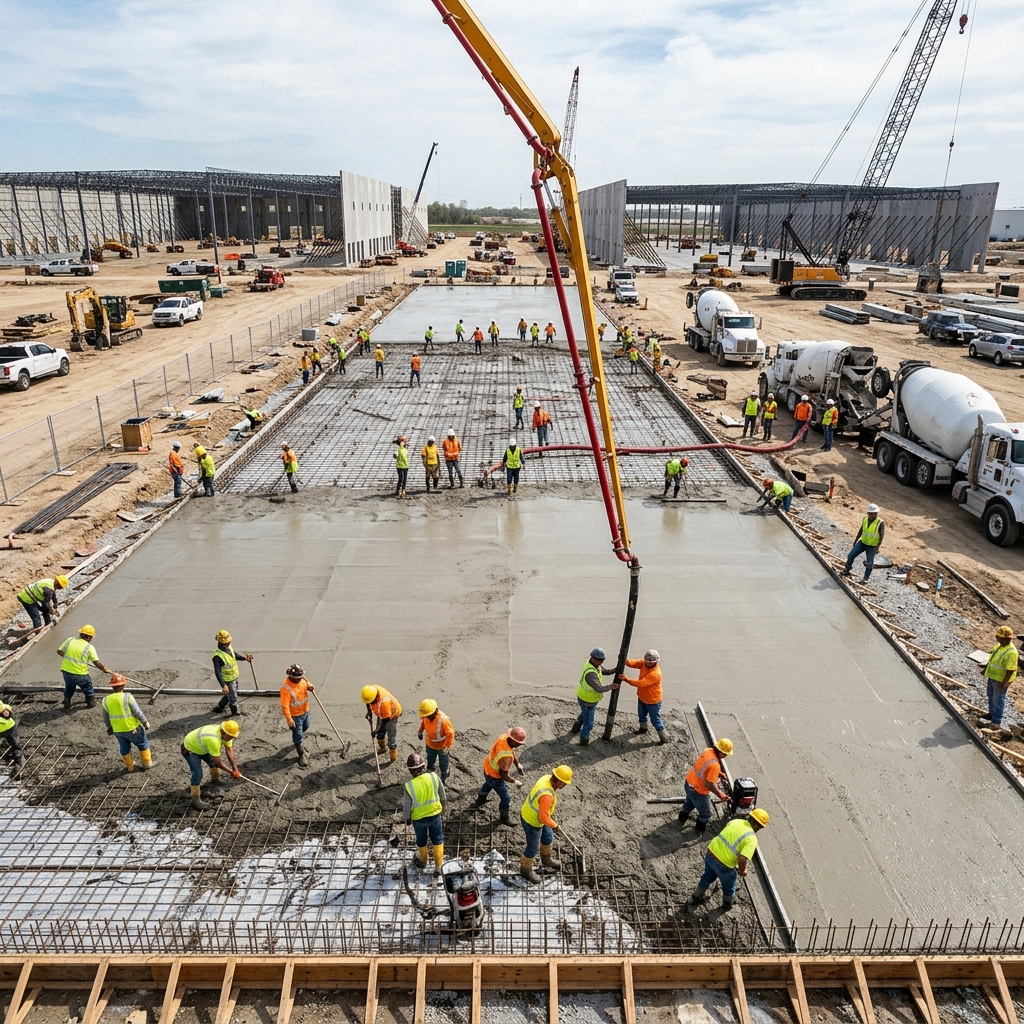
Tilt-wall panel fabrication means pouring your structural concrete walls horizontally, directly on concrete casting beds or pre-graded slab plates. Once this concrete reaches its design capacity (usually 4,000 PSI within 28 days), cranes hoist these massive panels vertically into position to form the building's outer shell.
Because tilt panels are cast flat and lifted upright, they undergo incredible tensile bending stresses during the lift. If the concrete isn't poured in a continuous, fast-moving sequence, **hydration cold-joint boundaries** will form between ready-mix loads. These cold lines act as internal fault cracks. When the crane pulls vertical tension, the load concentrates right along these cold boundaries, leading to surface cracking, concrete spalling, or even catastrophic panel failure.
"General contractors often underestimate panel lifting stresses. If your operator introduces a cold boundary during casting bed placements, that panel risks shear buckling the moment the crane pulls tension."
Putzmeister 47M Boom Articulation & Staging
Pouring a sprawling grid of 20 casting beds requires a pump rig with massive horizontal reach. Trying to reposition a heavy pump truck mid-pour slows down production and introduces high-pressure line hazards.
We deploy Putzmeister 47-Meter Roll-and-Fold boom pumps for these massive commercial slabs. Their 5-section boom opens in low-overhead environments, laying flat to reach across expansive grids without moving outriggers. However, managing tipping forces on loose coastal soils requires careful preparation. GCs must ensure the staging ground is compacted and firm before we set up:
Continuous Casting Bed Pour Timeline
Keeping your panels structural means pouring them fast and keeping the mud fresh. We manage every tilt-wall placement with a precise 5-step operational protocol:
-
1
Casting Grid Pre-Pour Check
Our operator walks the panel array to check that the steel reinforcement grids and chemical bond-breaker coatings are completely secure before pouring.
-
2
Soil Compaction & Pad Audit
We test the outrigger setup pads to check for soil shifts, laying down heavy-duty composite dunnage to prevent the truck from listing under load.
-
3
Synchronized Ready-Mix Flow
We coordinate directly with Cemex, Argos, or Vulcan batch plants to schedule a continuous transit queue, keeping ready-mix trucks arriving under 5-minute intervals.
-
4
Proportional Boom Placing
The operator uses proportional remote radio controls to sweep the boom smoothly, distributing fresh mud at exact panel depths without shifting rebar.
-
5
Panel Finish Curing Audit
Once the beds are leveled, we check the pour log to ensure there are no cold-joint boundaries, allowing structural curing to proceed safely.
Panel Casting Mix
Required concrete specifications for structural horizontal casting beds. We verify these specs with your supplier before dispatch.
Balanced slump for structural panel lifts
Clean aggregate prevents internal pockets
High paste supports structural hoisting
Ensures panels cleanly detach from bed
Tilt-Wall Prep Checklist
General contractors must confirm these site prerequisites before our boom pump operator deploys outriggers.
- Casting bed arrays fully laid out with bond-breaker applied.
- Ground compaction tests around the pump staging zone signed off.
- Overhead JEA airspace clearances marked and verified.
- Designated EPA-compliant concrete washout bag positioned.
- Argos or Vulcan truck delivery scheduled under 5-minute limits.
Casting Bed Rigging Parameters
Staging parameters for standard tilt-wall panel grids across Northeast Florida.
| Boom Rig Specification | Unfolding Height Limit | Max Outrigger Point Load | Airspace Clearance Buffer | Ideal Use Case |
|---|---|---|---|---|
| Putzmeister 47M Boom | 29.5 Feet (Standard) | 72,000 lbs (36 Tons) | 10 Feet (JEA Clear) | Maneuvering sprawling casting bed arrays flat. |
| Schwing 38M Boom | 24.0 Feet (Z-Fold) | 58,000 lbs (29 Tons) | 10 Feet (OSHA Clear) | Mid-size casting grids and tight structural setups. |
| 56-Meter Civil Boom | 38.2 Feet (Heavy) | 94,000 lbs (47 Tons) | 20 Feet (High Voltage) | Massive industrial warehouse slabs and civil grids. |
Soil Bearing Warning: Loose Coastal Sand Rigging
Northeast Florida coastal soils (especially in St. Johns, Ponte Vedra, and Fernandina Beach) are highly sand-heavy. Tipping forces on extended boom sweeps can cause outrigger shear failure. Compacted bases and extended dunnage cribbing are mandatory for standard 47M and 56M setups.
Tilt-Wall Placement FAQ
Common casting and outrigger setup questions from Jacksonville builders and developers.
How do you prevent structural cold joints in large panel arrays? +
We prevent cold-joint boundaries by locking in a dedicated ready-mix transit queue with local plants. We maintain less than 5-minute spacing between truck discharges at the hopper, ensuring a continuous wet-on-wet horizontal pour across casting grids.
What chemical bond breakers are used in tilt-up beds? +
General contractors apply a specialized chemical spray bond breaker directly onto the concrete casting bed before steel grids are staged. This forms a thin, non-reactive protective film that allows the vertical panel to cleanly detach from the horizontal bed during crane-hoisting operations without fracturing.
Why is the 47M Roll-and-Fold boom pump preferred for tilt-walls? +
Its 5-section boom opens flat (under 30 feet of height clearance) and extends horizontally up to 143 feet. This allows the operator to sweep the boom across wide casting layouts and reach deep panel corners in one setup, eliminating the need to reposition the truck mid-pour.
Ready to Stage Your Tilt-Wall Placement?
Tilt-wall pour schedules require early outrigger site audits and ready-mix queuing plans. Contact our direct logistics coordinators or request your boom pump online to secure your date.